> For the complete documentation index, see [llms.txt](https://docs.digibee.com/documentation/llms.txt). Markdown versions of documentation pages are available by appending `.md` to page URLs; this page is available as [Markdown](https://docs.digibee.com/documentation/troubleshooting/deployment-issues/route-conflicts.md).
# How to handle route conflicts in deployments
Learn how to proceed if these warnings are displayed in Run when a deployment needs to be made.
When a pipeline is ready to be deployed, you need to take a number of actions, i.e., select the size, concurrent executions, and replicas. However, it is important to pay attention to the routes specified in the **API Routes** in **Build**.
This is because if a route is specified that already exists, conflicts will occur and deployment of the same routes will not be possible.
## Parameter route warning
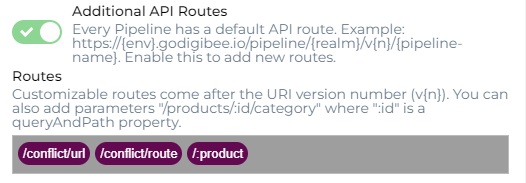
After you have made the configurations for the deployment, the last step is to click on **Deploy**. But if the **Additional API Routes** selected in the **Build** phase start with a parameter, this results in an error because a route has not yet been created and must not start with a parameter.
As you can see, when you use **/:product**, the original path to access the pipeline will be substituted.
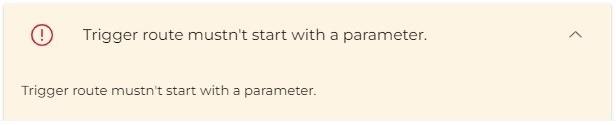
So, in Run, if the parameters for a route are not established, the message below will appear informing you of this and the deployment will not be able to proceed.
The correct way is to add a new route that gets a parameter - for example, **/product/:id** to solve this error.
## Same route warning
Another warning that appears when a deployment is to be made but an error is found is when a route is used that already exists in a different pipeline.
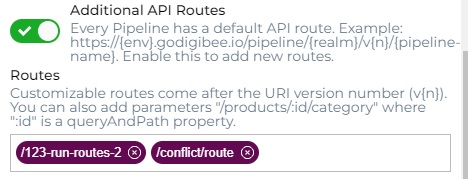
As we can see in the example below, the **/conflict/route** has already been used in a pipeline called **123-run-routes-2**.
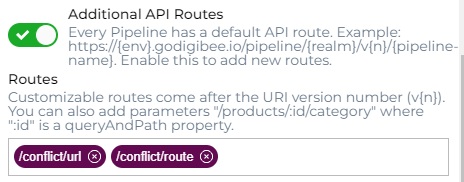
But if we set the same route, **/conflict/route**, in another pipeline as shown below, the different pipelines will have identical URLs, so only one of them will be executed.
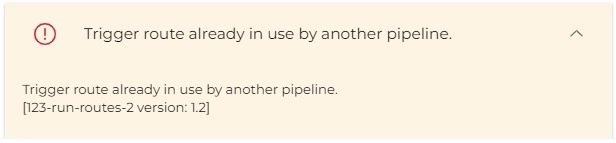
In Run, a warning before deployment informs that the route is already being used in another pipeline. So, you need to change the route in the **API Routes** in **Build** and then deploy it in Run.
To avoid this, we suggest using a naming pattern, for requests as well. This also brings some advantages, that is, greater control and security for these types of triggers (REST, HTTP and HTTP File), additional routes give more flexibility to pipelines and the user avoids double work when using legacies with less flexibility in terms of URL.
---
# Agent Instructions
This documentation is published with GitBook. GitBook is the documentation platform designed so that both humans and AI agents can read, navigate, and reason over technical content effectively. Learn more at gitbook.com.
## Querying This Documentation
If you need additional information that is not directly available in this page, you can query the documentation by asking a question.
Perform an HTTP GET request on the following URL with the `ask` and `goal` query parameters:
```
GET https://docs.digibee.com/documentation/troubleshooting/deployment-issues/route-conflicts.md?ask=&goal=
```
`ask` is the immediate question: it should be specific, self-contained, and written in natural language.
`goal` is what the user is ultimately trying to achieve, the reason they need the answer. Sharing it helps GitBook give you a better, more relevant answer. A goal is most helpful when it describes the outcome the user wants rather than restating the question. For example, with `ask=how do I create an API token`, a goal like `automate deployments from our CI pipeline` lets GitBook tailor the answer to that use case.
The response will contain a direct answer to the question and relevant excerpts and sources from the documentation.
Use this mechanism when the answer is not explicitly present in the current page, you need clarification or additional context, or you want to retrieve related documentation sections.