> For the complete documentation index, see [llms.txt](https://docs.digibee.com/documentation/llms.txt). Markdown versions of documentation pages are available by appending `.md` to page URLs; this page is available as [Markdown](https://docs.digibee.com/documentation/developer-guide/pt-br/development-cycle/overview/deployment/how-to-promote-pipelines-across-environments.md).
# Como promover pipelines entre ambientes
Saiba como alterar o ambiente de implantação de um pipeline.
Promover um pipeline previamente implantado de um ambiente não produtivo para outro ambiente escolhido é rápido e simples. Veja como fazer isso:
{% hint style="info" %}
Para ter acesso à **Implantação**, você deve ter a **permissão** de ***Deployment:***** Ler** e ***Deployment:***** Criar nos ambientes desejados (test/ prod)**, para sua conta de usuário ou um grupo ao qual você pertence.
{% endhint %}
## Passo 1: Selecionando o pipeline desejado
1. No ambiente não produtivo, vá até a página **Run** e selecione um pipeline implantado que deseja implantar em outro ambiente. A página Run inclui uma tag de ambiente no canto superior esquerdo com diferentes cores, facilitando a identificação do ambiente em que você está trabalhando.
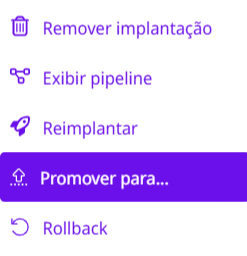
2. Após identificar o pipeline, clique nos três pontos no canto superior direito do cartão do pipeline e selecione **Promover para**.
## Passo 2: Promova o pipeline
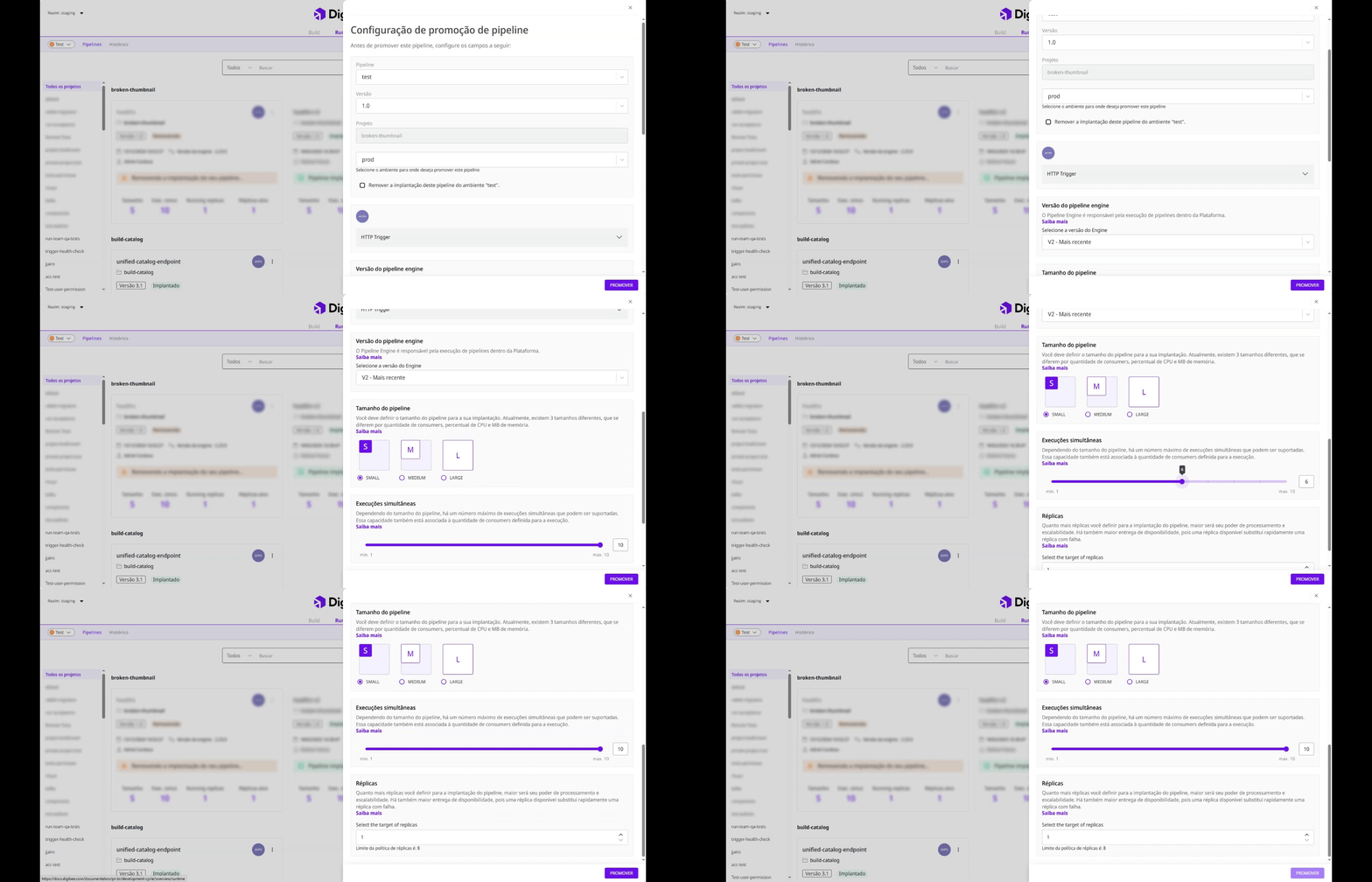
1. Ao clicar em **Promover para**, uma aba lateral será exibida com as configurações de implantação do pipeline. Faça as alterações necessárias.
{% hint style="info" %}
Você pode excluir este pipeline do ambiente atual após promovê-lo.
{% endhint %}
2. Depois de definir as configurações, clique em **Promover** para promover o pipeline ao ambiente desejado ou em **Cancelar** para voltar à tela anterior.
2. Verifique as configurações do passo anterior comparando o pipeline no ambiente não produtivo com os detalhes da implantação no ambiente selecionado.
Após promover um pipeline, você será redirecionado para a página Run do ambiente e projeto selecionados. O número de licenças consumidas por essa ação também será exibido.
## Passo 3: Verifique a situação atual do pipeline
Você pode verificar o status atual do pipeline diretamente no cartão do pipeline. Para saber mais sobre os status disponíveis no cartão, consulte a documentação sobre [status de implantação de pipeline.](/documentation/developer-guide/pt-br/development-cycle/overview/deployment/pipeline-deployment-status.md)
Também é possível conferir o status dos pipelines implantados mais recentemente na aba **Histórico**, na página Run. Saiba mais sobre [como verificar o histórico de implantação de pipelines](/documentation/developer-guide/pt-br/development-cycle/overview/deployment/pipeline-deployment-history-beta-restricted.md).
---
# Agent Instructions
This documentation is published with GitBook. GitBook is the documentation platform designed so that both humans and AI agents can read, navigate, and reason over technical content effectively. Learn more at gitbook.com.
## Querying This Documentation
If you need additional information that is not directly available in this page, you can query the documentation by asking a question.
Perform an HTTP GET request on the following URL with the `ask` and `goal` query parameters:
```
GET https://docs.digibee.com/documentation/developer-guide/pt-br/development-cycle/overview/deployment/how-to-promote-pipelines-across-environments.md?ask=&goal=
```
`ask` is the immediate question: it should be specific, self-contained, and written in natural language.
`goal` is what the user is ultimately trying to achieve, the reason they need the answer. Sharing it helps GitBook give you a better, more relevant answer. A goal is most helpful when it describes the outcome the user wants rather than restating the question. For example, with `ask=how do I create an API token`, a goal like `automate deployments from our CI pipeline` lets GitBook tailor the answer to that use case.
The response will contain a direct answer to the question and relevant excerpts and sources from the documentation.
Use this mechanism when the answer is not explicitly present in the current page, you need clarification or additional context, or you want to retrieve related documentation sections.